

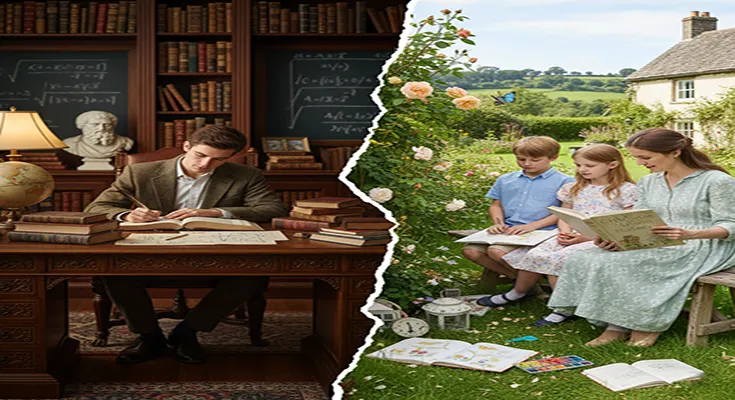
Choosing a homeschool philosophy can feel like navigating a maze of scholarly terms and passionate advocates. Two of the most respected and widely adopted methods are Classical Education and the Charlotte Mason (CM) Method. While both share roots in the pursuit of wisdom, virtue, and a broad, rich curriculum, their foundational approaches—particularly regarding how a child learns—create distinct experiences. Understanding these differences is key for parents seeking the best fit for their family.
Focus of the Curriculum: Tools vs. Ideas
The primary point of divergence lies in their method of knowledge acquisition, especially in the younger years:
- Classical Education (The Trivium): The modern Classical method is famous for its Trivium, dividing learning into three stages based on developmental readiness: Grammar (K-4, memorization of facts), Logic (5-8, critical reasoning), and Rhetoric (9-12, articulate expression). The focus in the Grammar stage is on providing a vast storehouse of facts—the “tools” of knowledge—that the student will learn to analyze and synthesize later. Rote memorization and structure are central to this foundation.
- Charlotte Mason (Living Ideas): Mason’s philosophy is rooted in the idea that “children are born persons” who require a “feast” of living ideas, not just dry facts. CM heavily emphasizes living books—high-quality, narrative-driven works written by passionate authors—over textbooks. She believed that ideas, once encountered, germinate in the mind and naturally draw in the facts needed to support them. Rote memorization, while present (e.g., in poetry and Scripture), is not the primary mechanism of learning.
Key Methodological Differences
The philosophical split translates into notable differences in daily practice:
| Feature | Classical Education | Charlotte Mason Method |
| Primary Method | Socratic Dialogue, Explicit Grammar/Logic Instruction, Memorization. | Narration (oral and written retelling), Short Lessons (10–20 mins). |
| Text Usage | Great Books and foundational texts of the Western Canon; structured textbooks for subjects like Latin and Logic. | Living Books (rich, narrative literature); little use of dry textbooks or workbooks. |
| Nature Study | Included, often within a structured science or liberal arts context. | Integral and regular, often involving nature walks and detailed nature journaling. |
| Learning Pace | Structured, often with a clear, fixed progression through the Trivium stages. | Gentle, with an emphasis on “Festina Lente” (make haste slowly), allowing ideas to be absorbed. |
The Role of Logic and Character
Another significant difference is the emphasis on reason. Classical education dedicates the entire Logic stage to training the student in formal reasoning and debate. While Mason valued logic, she cautioned against emphasizing it over character and virtue. She focused heavily on habit training (of attention, obedience, truthfulness) believing that sound principles and character should govern reason.
Ultimately, neither approach is inherently superior; they are two paths toward the shared goal of cultivating a well-educated, moral, and thoughtful individual. Classical education typically suits students who thrive on rigorous structure and detailed memorization, while the Charlotte Mason method often appeals to the child who flourishes with rich literature, nature, and a more gentle, idea-rich environment.