Diabetes self-management is a complex, demanding task, requiring patients to understand medication schedules, dietary restrictions, and blood glucose monitoring. However, standard educational materials often rely on reading levels far exceeding the national average. For the millions of adults with low health literacy, these materials become a barrier, not a bridge, leading to poorer adherence and health outcomes. Therefore, developing highly effective diabetes self-management education materials for low literacy patients is not just beneficial—it is an ethical imperative.
The Imperative for Visual and Simple Communication
Low literacy affects a patient’s ability to understand written instructions, calculate dosages, and interpret charts. Traditional text-heavy pamphlets must be replaced with materials that prioritize visual communication and simplicity.
1. Focusing on “Need-to-Know” Information
Educational content must be streamlined, focusing only on the most critical, actionable information. Instead of explaining the pathophysiology of insulin resistance, materials should focus on the “Four Key Actions”:
- Take medication correctly.
- Test blood sugar as directed.
- Eat healthy portions.
- Be physically active.
Each action should be presented on its own dedicated page or card, ensuring minimal cognitive load.
2. Visual Over Verbal: Using Teach-Back
The cornerstone of low-literacy education is the use of high-quality visuals and the Teach-Back Method.
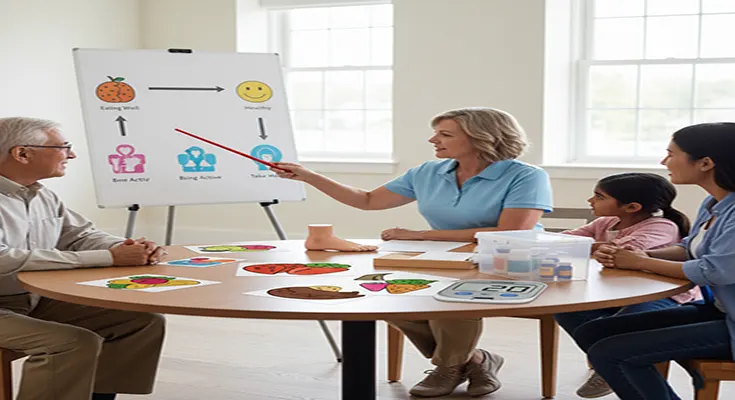
- Graphics and Icons: Use universally recognizable icons and simple, medically accurate illustrations rather than abstract stock photos. For instance, explaining meal portions should use the Plate Method (half non-starchy vegetables, quarter protein, quarter starch) with clear, colorful diagrams.
- Plain Language: All text should be written at a 5th-grade reading level or lower. Use short sentences, common words, and an active voice. Technical terms (like hypoglycemia) must be replaced with simple, actionable phrases (like very low blood sugar).
- The Teach-Back Method: After presenting a concept (e.g., how to use an insulin pen), the healthcare provider asks the patient, “Can you show me how you will do this at home?” This confirms understanding and identifies areas of confusion without making the patient feel tested.
Examples of Effective Materials
| Material Type | Low-Literacy Approach | Focus |
| Medication Schedule | Color-coded pill organizers or picture charts showing the time of day (e.g., a rising sun for morning dose). | Dose Calculation/Timing |
| Blood Sugar Monitoring | Step-by-step visual guides demonstrating the lancing and testing procedure, numbered 1, 2, 3. | Procedural Skill |
| Foot Care | A series of clear images showing how to check feet daily (top, bottom, between toes) and what to look for (cuts, blisters). | Risk Prevention |
By prioritizing simple language, clear visuals, and interactive teaching methods like Teach-Back, healthcare providers can effectively deliver diabetes self-management education materials for low literacy patients. This ensures that complexity is managed by the educator, allowing the patient to focus on the essential tasks that lead to better long-term health and well-being.